


Fill a measuring cylinder with water and look at the surface from the side. The water doesn't sit flat. It curls up the glass wall like a tiny hill running around the rim. Now picture the classic physics demonstration with mercury in a glass tube: it does the opposite and bulges upward in the middle. Same glass, same gravity, two opposite curves. If you can explain that, you already understand half of this topic.
Why does water climb a glass wall?
Because the water molecules like the glass more than they like each other. I used to mix up cohesion and adhesion until a lecturer gave me one question to ask every time: who is being pulled toward whom? Ask it, and the two terms stop swapping places in your head. I'm writing this page because these five properties show up together in most physical-agents and hydrotherapy syllabi, and most notes treat them as five unrelated definitions.
Here's the version you can quote in an exam.
Cohesion is attraction between molecules of the same substance. Adhesion is attraction between molecules of different substances, like water and glass. Together they decide whether a liquid beads up, spreads out or climbs a wall, and they set the stage for surface tension, viscosity and density.
That "climb" you saw is the whole story in miniature. Water molecules at the wall are pulled toward the glass (adhesion) and toward each other (cohesion). Adhesion wins, so the edge rises. The rest of this article follows the same logic: one picture of molecules pulling on each other, applied five times.
Cohesion versus adhesion: the meniscus tug of war
Take the glass tube again. Inside water, every molecule is pulled equally in all directions by its neighbours, so the pulls cancel. At the wall, a new player appears: the glass molecules. Water adheres strongly to clean glass, so the edge of the water gets dragged upward. The surface forms a concave curve called a meniscus.
Mercury plays the game differently. Its atoms attract each other far more strongly than they attract glass. Cohesion wins, the edge is held back, and the middle stands proud. That gives a convex meniscus.
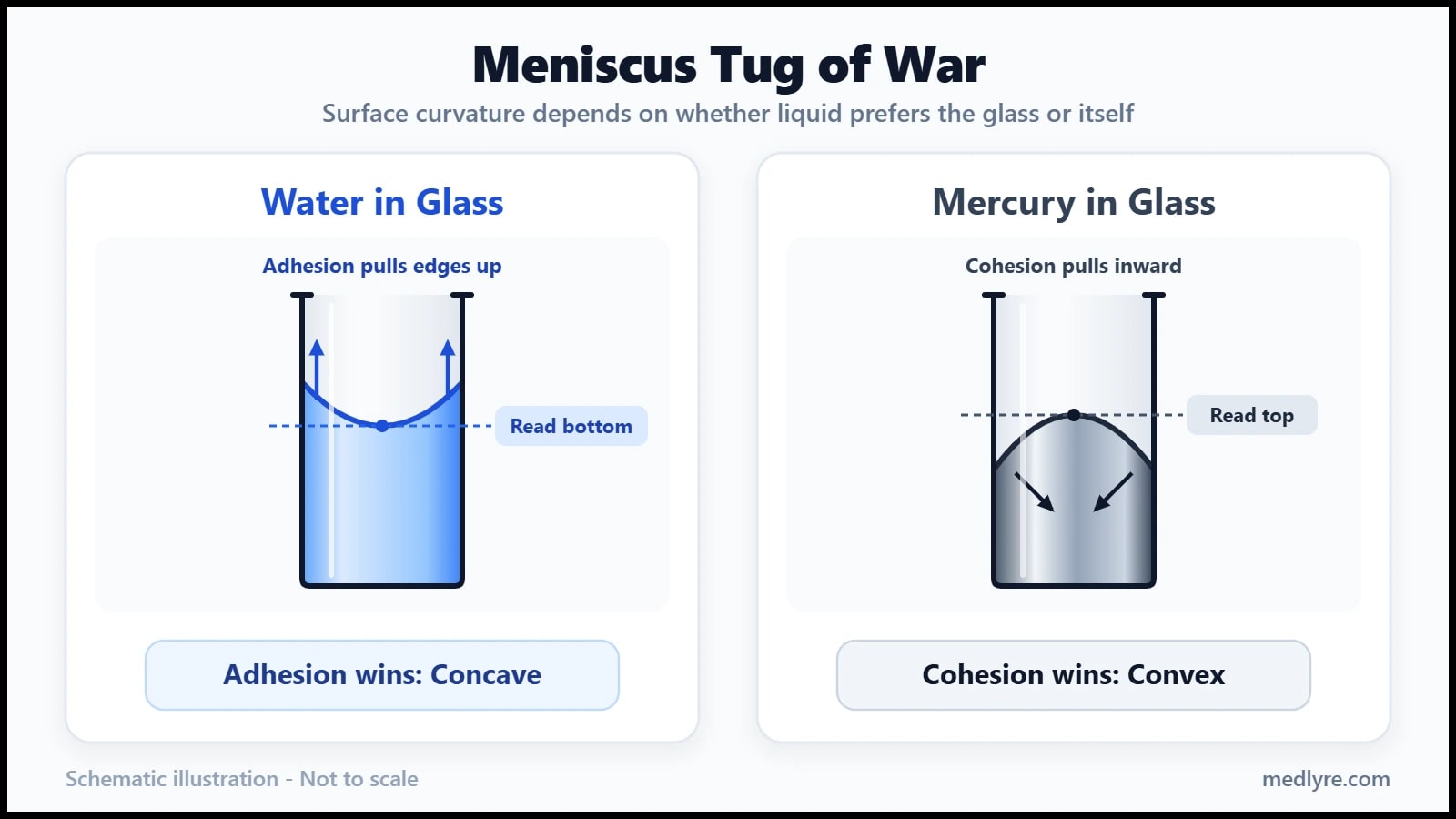
Notice what the figure does for the exam. You don't have to memorise "water concave, mercury convex" as two facts. You memorise one rule (the bigger pull wins) and the curves follow.
This also explains a classic reading error in practicals. For water, read the level at the bottom of the curve, away from the wall's pull. For mercury, the convention flips: read at the top of the dome.
Where students slip
Cohesion and adhesion are both forces of attraction, so neither has a single standard property unit the way density does. Examiners usually ask which one dominates in a given situation.
That tug of war has a second consequence, and it happens at the top of the liquid, not at the wall.
The liquid's skin
Surface molecules have neighbours below and beside them but almost none above. They get pulled inward and sideways, so the surface behaves like a stretched elastic film. That film is surface tension: the force along the surface per unit length (N/m). For water it's about 72 mN/m at room temperature, and it falls as the water warms. Mercury's is several times higher, which is cohesion at work again.
This is why a needle can rest on water and a pond skater can walk across it. It is also why detergent matters in medicine. Soap and other surfactants collect at the surface and weaken the cohesive pull between water molecules there.
Your lungs make their own surfactant (type II alveolar cells produce it) for exactly this reason. Pull it out and see what gives way: alveoli, lined with a thin water film, feel a strong inward squeeze. The Laplace relationship, , says that at the same surface tension the smaller the alveolus, the higher the collapsing pressure, so the small ones shut first. That is the physics behind respiratory distress syndrome in premature newborns, a story you'll meet again in respiratory physiology.
Honey, water, blood: what viscosity actually measures
Stir water with a spoon, then stir honey. The honey fights back. That fight is viscosity, the internal friction between layers of fluid as they slide past each other. It isn't about stickiness to the spoon (that's adhesion). It's about layers rubbing on layers inside the liquid.
Water's viscosity (quoted as dynamic viscosity in Pa·s, or mPa·s, which equals the older unit centipoise) is about 1.0 mPa·s at 20 °C and about 0.7 at body temperature. Warm any liquid and the molecules slip past each other more easily, so viscosity drops. Gases do the reverse: their viscosity rises with temperature, a favourite exam curveball.
Blood sits well above water. Guyton and Hall's Textbook of Medical Physiology puts whole blood at roughly three times the viscosity of water at normal haematocrit (the fraction of blood volume taken up by red cells). Raise the haematocrit, as in polycythaemia, and blood gets thicker and resists flow more.
Now the part that matters for your clinic years. When you move a limb through water, the water pushes back, and the push grows with speed. Aquatic exercise teaching, including the aquatic section of Kisner and Colby, uses this to progress resistance: slow movement meets little resistance, fast movement meets a lot. Move faster still and the flow turns turbulent, so the drag climbs steeply. In Becker's PM&R review, viscosity is described as the internal friction of a fluid in motion, and the review treats it as one of the properties that account for immersion's biological effects.
Here's the practical consequence. Water gives resistance that matches the effort the patient puts in, so you can grade it without weights. Change the speed, or the surface area of the limb or paddle, and the resistance changes with it.
What breaks if you ignore this? Imagine a pool session where the therapist asks a deconditioned patient for "fast kicks". Fast movement means high drag, so the patient meets far more resistance than the instruction seemed to imply. Speed, surface area and viscosity together set how hard the water pushes back, so the instruction you give is part of the dose.
| Fluid | Viscosity (approx.) | What to remember |
|---|---|---|
| Water, 20 °C | 1.0 mPa·s | The reference |
| Water, 37 °C | 0.7 mPa·s | Warming lowers viscosity |
| Whole blood | About 3x water | Rises with haematocrit |
| Honey | Thousands of times water | The classroom example |
Why does the body float at all?
Density is mass per unit volume. Water is about 1000 kg/m³ (1 g/cm³). Relative density, also called specific gravity, is a fluid or body's density divided by water's, so it has no unit. In water, anything with a relative density below 1 floats and anything above 1 sinks.
The human body with lungs full of air sits a little below 1 (about 0.97 is the figure often quoted), which is why you float with your head just above the surface. Fat is less dense than water, while bone and muscle are denser, so more fat tends to mean more float and denser bone tends to mean less. Physiopedia's aquatherapy page lists density, buoyancy and hydrostatic pressure among the physical properties that matter in the pool. Lung volume matters too: a full breath lowers your overall density.
Density also controls pressure. Water pressure at depth (above atmospheric) is , where is density, is gravitational acceleration and is depth. That works out to roughly 74 mmHg for each metre of fresh water. Becker's review notes that hydrostatic pressure helps resolve oedema in an injured part, which is why the ankle is squeezed hardest at the bottom of the pool. The same pressure shifts blood toward the chest and compresses the chest wall, a mechanism you'll revisit when you study why cardiac and respiratory conditions need extra care in hydrotherapy.
One more trap: oil floats on water but is more viscous. Density and viscosity answer different questions. Sit with that for a second, because it's the single most common mix-up.
Five questions, five properties
You now have five words. The fastest way to stop them blurring together is to give each one the question it answers.
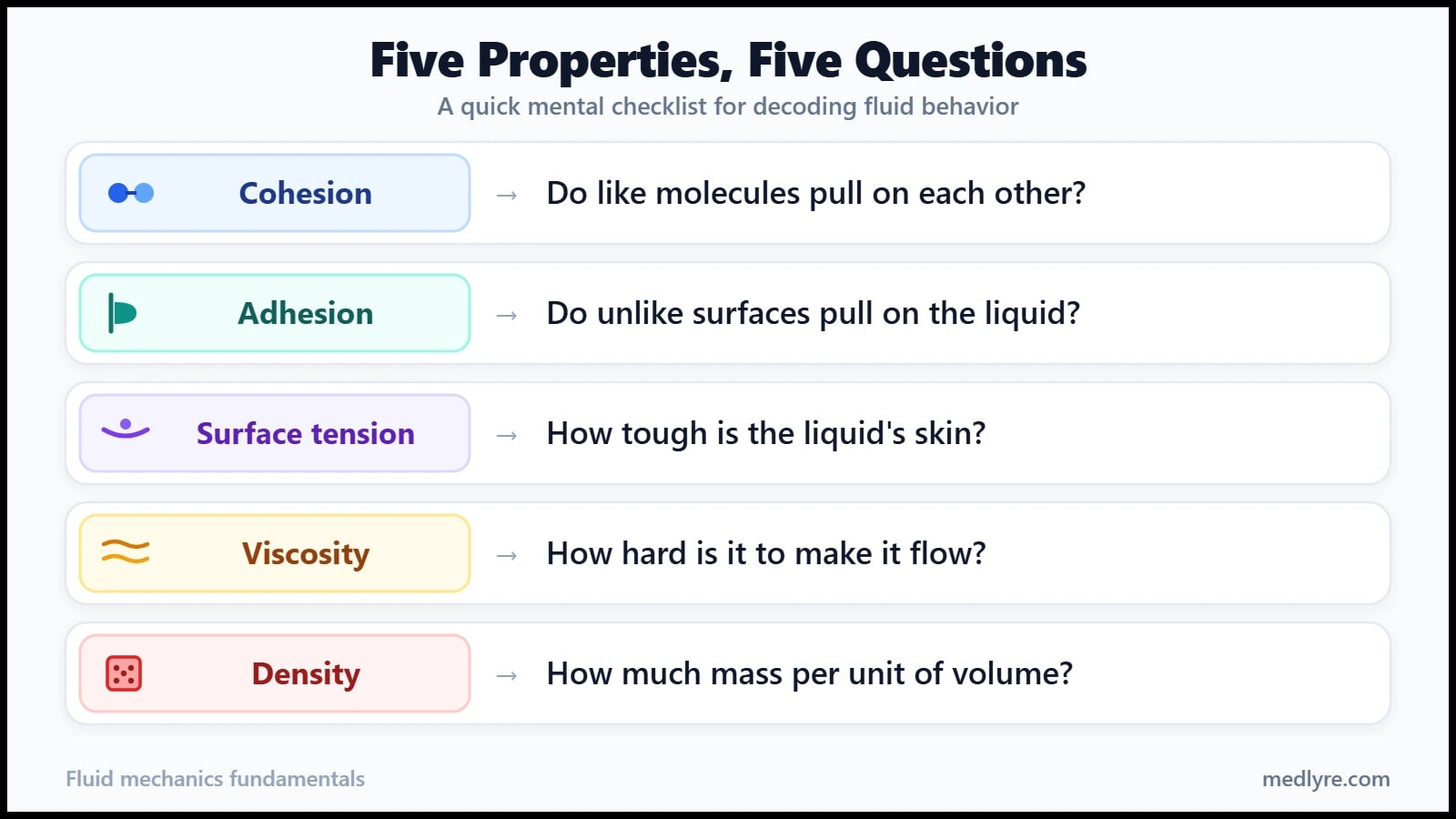
Why does this matter beyond the viva? Because physical agents lean on these properties constantly. The Cameron Physical Agents in Rehabilitation text explains that an ultrasound transducer needs a coupling medium because air between head and skin blocks the beam. Gel works because it wets the skin and the transducer face and displaces the air. Skip the gel and see what gives way: the sound reflects at the air gap and the tissue receives almost none of it.
Similar wetting logic applies to electrode pads and conductive gels in electrotherapy. A thin conductive film fills the gaps between a rough electrode and the skin, which lowers contact impedance and spreads current more evenly.
| Property | Question it answers | SI unit | Classic trap |
|---|---|---|---|
| Cohesion | Like pulls like | Force of attraction (N); no standard property unit | Confused with adhesion |
| Adhesion | Unlike pulls unlike | Force of attraction (N); no standard property unit | Confused with cohesion |
| Surface tension | Strength of surface film | N/m | Confused with viscosity |
| Viscosity | Resistance to flow | Pa·s (dynamic viscosity) | Mistaken for density (oil on water) |
| Density | Mass per volume | kg/m³ | Mixed with relative density |
Ninety seconds before the viva
The short version
- Cohesion pulls like to like. Adhesion pulls unlike to unlike. The bigger pull sets the meniscus.
- Surface tension is the inward pull on surface molecules, in N/m. It drops as temperature rises, and surfactants lower it.
- Viscosity is internal friction in a moving fluid. Drag in water rises with speed, which is how pool resistance gets dosed.
- Density is mass per volume. Below water's density you float, above it you sink.
- Hydrostatic pressure is , about 74 mmHg per metre of water.
- Oil on water proves density and viscosity are different things.
Questions students keep asking about these five
Q. Is surface tension the same as viscosity?
No. Surface tension acts at the boundary of a liquid and gives it a skin. Viscosity acts throughout the liquid and measures resistance to flow. A liquid can have high surface tension and low viscosity, and the reverse.
Q. Why is mercury's meniscus convex?
Mercury atoms attract each other more than they attract glass, so cohesion dominates adhesion and the surface bulges up in the middle.
Q. Does heating a liquid change these properties?
Yes. Surface tension and the viscosity of a liquid both fall as it warms, and density usually falls slightly too (water between 0 and 4 °C is a famous exception). Gas viscosity does the opposite and rises with temperature.
Q. What is the difference between density and relative density?
Density has units (kg/m³). Relative density divides by water's density, so it has none. Below 1 means float in water.
Q. Why do heavy people sometimes float better?
Overall density decides it, not weight alone. Fat is less dense than water and bone and muscle are denser, and a lungful of air lowers your density further.
Q. Why do I need gel in ultrasound?
The gel wets the skin and displaces air, so sound can enter the tissue instead of reflecting off an air gap.
For students, not patients
Everything in this article exists to help students understand a topic they struggle with. It is not a treatment guide, not a clinical protocol, and not a substitute for the curriculum your institution follows. Bedside decisions always need qualified supervision and full patient assessment.
References
- Hall JE, Hall ME. Guyton and Hall Textbook of Medical Physiology. 14th ed. Elsevier; 2020.
- Kisner C, Colby LA, Borstad J. Therapeutic Exercise: Foundations and Techniques. 7th ed. F.A. Davis; 2017.
- Cameron MH. Physical Agents in Rehabilitation: From Research to Practice. 5th ed. Elsevier; 2017.
- Becker BE. "Aquatic therapy: scientific foundations and clinical rehabilitation applications." PM&R. 2009. Direct URL.
- Physiopedia. "Aquatherapy." Physiopedia. https://www.physio-pedia.com/Aquatherapy (accessed 2026).