

Slide your fingertips along your own forearm toward the elbow. The hand glides and the skin stays where it is. Now press a little harder and shift the fingers in a tight circle so the skin travels with them. Same forearm, same fingers, and you've just performed two different massage manipulations: effleurage first, then friction.
The five massage manipulations and how they differ
When we teach these strokes in the practical room, students learn the names fast and lose them just as fast, because a name tells the hand nothing. What makes them stick is narrating the hand out loud: what is touching, what is moving, and what is happening to the tissue underneath. This write-up is built so that a stroke description in a question paper maps at once to a name, a direction and an expected effect.
Massage manipulations are the classified hand movements used to treat soft tissue. The classical set has five: effleurage (stroking), petrissage (kneading), friction (small deep circles or transverse rubs), tapotement (rhythmic percussion), and vibration (fine trembling). Each differs by contact, pressure, direction and rhythm, which decides its effect.
The names are French, and each one describes its movement: effleurer means to skim the surface, pétrir to knead, tapoter to tap. In the first of his two British Journal of Sports Medicine papers, Goats sets out the manual techniques systematically before turning to the mechanical ones, and most physiotherapy courses follow the same order.
| Manipulation | Meaning of the name | What the hand does | Pressure and direction | Main purpose |
|---|---|---|---|---|
| Effleurage | Skimming, stroking | Long glide with the palm moulded to the part | Light to moderate; toward the heart on limbs | Spread contact, prepare tissue, assist venous and lymph return |
| Petrissage | Kneading | Lifts, squeezes and releases the muscle belly | Moderate to deep, intermittent | Mobilise muscle bulk, pump fluid onward |
| Friction | Rubbing | Small circles or transverse movements; skin moves with the fingers | Deep, localised | Work one spot such as a scar or tendon |
| Tapotement | Tapping, percussion | Rapid alternating strikes from the wrist | Light to firm, rhythmic | Stimulation; loosening chest secretions (cupping) |
| Vibration | Trembling | Fine oscillation with the hand held in place | Light, continuous | Fine stimulation, relaxation, chest work |
Figure 1 turns each row of that table into a hand path, so you can revise the five strokes as five shapes.
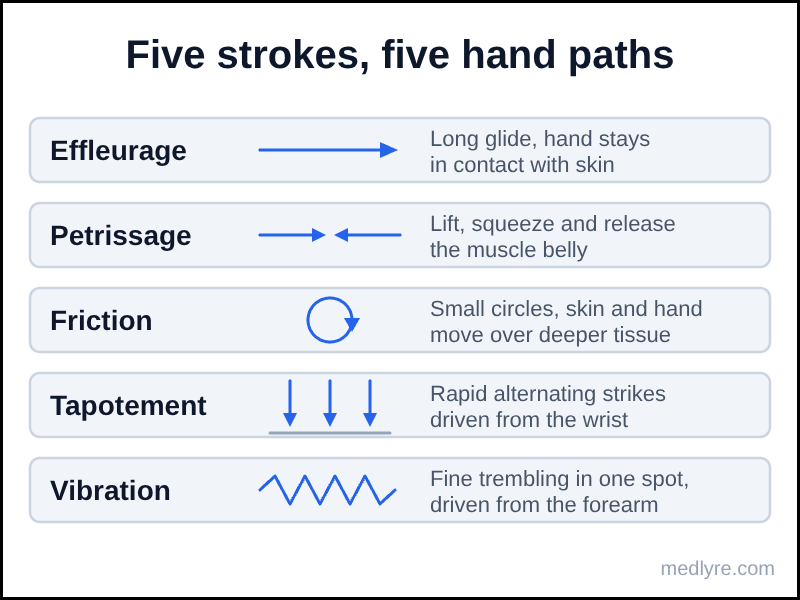
One question sorts the whole list: what is moving relative to what? In effleurage the hand moves over the skin. In friction the skin moves with the hand, over deeper tissue. Petrissage lifts the tissue itself and squeezes it, tapotement strikes and rebounds, and in vibration the hand holds still while it trembles.
Start with the stroke that opens every session, because its direction is the first thing a viva examiner checks.
Why does effleurage always travel toward the heart?
Effleurage is a long, smooth glide in which the whole palm moulds to the part, and on a limb the working stroke runs toward the heart. The reason sits inside the vessels. Veins and lymphatic vessels carry one-way valves, so fluid can only travel toward the heart, and a stroke that follows that direction squeezes the contents forward while the valves stop them slipping back.
Under the fingers, you feel this as a slow wave of pressure that starts at the distal edge of your hand and finishes at the proximal edge. On the forearm, that means wrist toward elbow, with the hand following the curve of the limb.
What happens if you stroke the other way? The valves close against the flow, so the pressure fights the anatomy instead of borrowing it, and the stroke does little for return flow.
Where students slip
Classical effleurage applies its pressure on the stroke toward the heart. The hand then returns to the start with featherlight contact or no pressure at all. Students who press on both strokes turn the return into a push against the valves.
Depth changes the character of the stroke while the direction rule stays put. A light, superficial glide introduces contact and spreads lubricant. A deeper glide, still centripetal, reaches the fluid in the tissue below. Because it is gentle and continuous, effleurage also links one manipulation to the next, and its slow rhythm lets your hands read warmth, texture and tone before you commit to anything deeper.
The second paper by Goats reviews research on blood flow, oedema, connective tissue, muscle and the nervous system, and concludes that using massage in sports medicine can be justified by orthodox scientific criteria, while admitting that some areas still need investigation.
Gliding moves fluid, but it can't get a grip on the muscle itself. For that, the hands have to pick the tissue up.
Petrissage lifts, squeezes and releases the muscle belly
Petrissage takes hold of the muscle belly, lifts it away from the structure beneath, squeezes it and lets go. Nothing slides across the skin. The tissue moves with the hands, and the rhythm of squeeze and release acts as a pump on the fluid inside the muscle.
Kneading bread dough is the closest everyday equivalent: the heel of the hand pushes, the fingers fold the dough back, and the whole mass stays under your control. Petrissage comes in four forms. Kneading uses the palms, fingers or thumbs, picking up lifts the belly between thumb and fingers, and skin rolling pulls a fold of skin and fascia along. Wringing sends the two hands in opposite directions across the muscle, much like twisting a wet towel.
The 2005 review by Weerapong, Hume and Kolt groups the mechanisms of massage into biomechanical, physiological, neurological and psychological, and expects mechanical pressure to increase muscle compliance. The same review notes that the mechanisms of each individual technique have not been widely investigated, so treat any claim about what petrissage "flushes out" as a hypothesis.
What happens if you knead a freshly torn muscle? The squeeze and stretch add mechanical stress to tissue that is already bleeding and swollen, and that reasoning underlies the textbook caution against deep work on acute injuries.
Petrissage works the whole belly at once. When the problem sits in one small spot, the hands have to narrow down.
Friction: fingertips grip the skin and move the tissue below
Friction uses the thumb pad, finger pads or heel of the hand over a small area, with enough pressure that the skin and the layer just under it shift over deeper structures. Circular friction moves in small circles. Transverse friction moves across the direction of the fibres, as in Cyriax's deep transverse friction, which his volume on manipulation, massage and injection describes for tendons and ligaments.
The confusion most people carry
Friction sounds like a faster, harder effleurage. The two differ in what slips. In effleurage the hand slips over the skin. In friction nothing slips against the skin: skin and fingers travel together and the layers underneath are the ones being moved.
That difference explains the lubricant rule. Effleurage needs slip, so it uses oil or cream. Friction needs grip, so it goes on dry or with very little lubricant.
Textbooks describe local warmth, hyperaemia (increased local blood flow) and a short-lived analgesic effect from friction, and many courses teach that it frees tissue that has stuck together after injury. Direct evidence for individual strokes is limited, as the Weerapong review points out for massage in general, so teach the adhesion idea as taught rather than proven. Because the stroke is deep and local, it can also aggravate tissue that is already irritable, and the cautions later in this article trace back to that.
Three strokes so far, and all three work by pressure and movement. The last two depend on rhythm.
Tapotement and vibration: strokes driven by rhythm
Tapotement is rapid, rhythmic striking, and every form of it is driven from the wrist. Hacking uses the ulnar borders of both hands in alternation, with loose fingers. Clapping, also called cupping, uses a cupped palm. Beating uses loosely closed fists, and pounding uses the ulnar border of the closed fist. In each, the hand springs off the tissue and rebounds, and a stiff wrist turns a stimulating stroke into a painful one.
Textbooks present tapotement as stimulating: it excites sensory nerve endings and briefly raises muscle tone, which is why it sits late in a classical sequence. Over the chest wall, cupped percussion has a different job. The respiratory text by Pryor and Prasad describes it, along with vibrations and shakings applied during expiration, as a way to help loosen secretions.
Vibration has the opposite mood. The hand stays on one spot while the forearm muscles tremble it rapidly, so the contact is fine and light. Shaking is its coarser relative: the therapist picks up a muscle belly or a limb and oscillates it.
Older texts often use four classes, with vibration filed under tapotement, and some courses separate shaking from vibration or rocking from petrissage. Both layouts sort the same movements, so quote the five-way list and name the variant if the question asks about classification.
With all five in hand, the useful question becomes which one to reach for.
Which stroke fits which aim, and where does caution begin?
A classical session usually opens with effleurage, moves to petrissage, adds friction where one spot needs it, uses tapotement or vibration when stimulation is wanted, and closes with effleurage again. Figure 2 reverses that view and starts from the aim.
flowchart TD
  A["Aim of the stroke"] -->|"spread contact, assist return flow"| B["Effleurage"]
  A -->|"mobilise the muscle belly"| C["Petrissage"]
  A -->|"reach one tendon or scar"| D["Friction"]
  A -->|"stimulate, loosen chest secretions"| E["Tapotement"]
  A -->|"fine stimulation, ease tension"| F["Vibration"]
Figure 2: Matching each massage manipulation to the aim it serves.
Evidence for those aims is modest, and an honest answer says so. The Weerapong review reports that post-exercise massage reduces the severity of muscle soreness but has no effect on loss of muscle function. Hemmings and colleagues tested eight amateur boxers and found support for psychological benefits, but raised questions about physiological restoration and repeated performance.
The cautions, and the mechanism behind each
Examiners rarely accept a bare list of contraindications. They want the reason, and each reason traces to what the strokes physically do to tissue.
| Situation | Why textbooks list it |
|---|---|
| Acute inflammation or a fresh muscle tear | Added mechanical stress and blood flow can worsen swelling and bleeding |
| Suspected deep vein thrombosis or thrombophlebitis | Pressure and fluid movement risk dislodging a clot, which could travel as an embolus |
| Open wounds, infected or fragile skin | Contact can spread infection and shear weak skin |
| Malignancy at the site | Local massage is avoided because of a theoretical risk of spreading disease |
| Bleeding disorders or anticoagulant therapy | Deep strokes can cause bleeding into the tissue |
| Skin with reduced sensation | The recipient cannot report pain or excess pressure |
The viva trap here
Asked why deep vein thrombosis rules out massage, "it can spread" loses the mechanism. The full answer names the clot, the squeeze-and-release action of the strokes, and the embolus that could follow.
Stroke, contact, effect: the revision card
Revision snapshot
- Five manipulations: effleurage, petrissage, friction, tapotement, vibration. Some older texts count four, with vibration under tapotement.
- Sorting question: what moves relative to what?
- Effleurage glides toward the heart on limbs, with a featherlight return, and opens and closes the session.
- Petrissage lifts, squeezes and releases the muscle belly, and the tissue moves with the hands.
- Friction grips the skin and moves the layers beneath, in circles or across the fibres, with little lubricant.
- Tapotement strikes and rebounds from the wrist (hacking, clapping, beating, pounding). Vibration trembles in one spot, and shaking is its coarser form.
- Every caution traces back to what the stroke does mechanically to tissue.
- Evidence: soreness severity falls, functional loss does not, and data on individual strokes is thin.
Straight answers on massage strokes
Q. How many massage manipulations are there?
Classical massage describes five manipulations: effleurage, petrissage, friction, tapotement and vibration. Some older texts count four, folding vibration into tapotement, and some split rocking from petrissage or shaking from vibration. For exams, learn the five-way list and mention the variant if the question asks about classification. Each is defined by what the hand does and how the tissue responds.
Q. What is the difference between effleurage and friction?
In effleurage the hand glides over the skin along a long path with light to moderate pressure. In friction the fingertips grip the skin and move it, with the tissue beneath, in a small circle or across the fibres. Effleurage covers a wide area and spreads contact; friction stays on one spot and works deep. If your fingers slip across the skin, that is effleurage. If the skin travels with them, that is friction.
Q. Why is tapotement used in chest physiotherapy?
Percussion with a cupped hand over the chest wall helps loosen secretions so they can be coughed up, as the chest physiotherapy text by Pryor and Prasad describes. Elsewhere on the body, textbooks present tapotement as stimulating: it excites sensory nerve endings and briefly raises muscle tone, so it sits late in a classical sequence. Examiners often link cupping to chest conditions and hacking to large muscle groups.
Q. What is the difference between vibration and shaking?
Vibration is a fine, rapid trembling produced by the therapist's forearm muscles, with the hand held in contact at one spot. Shaking is coarser and slower, moving a whole muscle belly or limb back and forth. Both are rhythmic oscillations and both use light pressure. Chest physiotherapy texts pair vibration and shaking with the breathing cycle, applying them during expiration.
Q. Which massage manipulation is used first and last in a session?
Effleurage, at both ends. It opens the session so the recipient gets used to your touch and your hands can read tissue warmth, texture and tone. In the middle it links one manipulation to the next so the rhythm doesn't break, and at the close it settles the area again. Examiners like answers that mention continuity.
Q. Does massage speed up recovery after exercise?
The evidence is modest. The 2005 Weerapong review found that post-exercise massage reduced the severity of muscle soreness but did not change loss of muscle function. A 2000 trial in amateur boxers by Hemmings and colleagues supported psychological benefits yet questioned physiological restoration. Claims about flushing out toxins deserve caution, because the mechanisms of each individual stroke are still thinly studied.
Educational Use Only
This article is written for educational purposes for health-science students. It is not medical advice and never replaces clinical training, professional judgment, or your institution's curriculum. Real clinical decisions always require proper patient assessment under qualified supervision.
References
- Goats GC. "Massage: the scientific basis of an ancient art: Part 1. The techniques." Br J Sports Med. 1994;28(3). doi.1136/bjsm.28.3.149. PMID 8000809. Full text.
- Goats GC. "Massage: the scientific basis of an ancient art: Part 2. Physiological and therapeutic effects." Br J Sports Med. 1994;28(3). doi.1136/bjsm.28.3.153. PMID 8000810. Full text.
- Weerapong P, Hume PA, Kolt GS. "The mechanisms of massage and effects on performance, muscle recovery and injury prevention." Sports Med. 2005;35(3). doi.2165/00007256-200535030-00004. PMID 15730338. PubMed.
- Hemmings B, Smith M, Graydon J, Dyson R. "Effects of massage on physiological restoration, perceived recovery, and repeated sports performance." Br J Sports Med. 2000;34(2). doi.1136/bjsm.34.2.109. PMID 10786866. Full text.
- Cyriax JH. Textbook of Orthopaedic Medicine, Volume 2: Treatment by Manipulation, Massage and Injection. Baillière Tindall.
- Pryor JA, Prasad SA, eds. Physiotherapy for Respiratory and Cardiac Problems. Churchill Livingstone.