

Here's the odd thing about high-frequency currents: you can push dozens of watts through a knee and the patient reports warmth, nothing else. No buzzing, no twitching. A TENS current carrying a sliver of that power would have them gripping the couch.
Hold that puzzle for a few minutes. By the end, the warmth, the missing tingle, the number 27.12 you keep memorising and the word "harmonics" will all hang off one idea.
What counts as a high-frequency current, and why is it 27.12 MHz?
High-frequency currents are alternating currents above about 100 kHz, and in therapy they mean shortwave diathermy at 27.12 MHz (wavelength about 11 m) and microwave diathermy at 2450 MHz. They produce deep heating in tissue through an oscillating electromagnetic field, without stimulating nerve or muscle.
Diathermy (Greek for "heating through") is the umbrella term for deep heating by this kind of energy. Textbooks draw the "high-frequency" line at slightly different places, so don't panic if your lecture notes say 100 kHz and your book says 1 MHz. Everything clinically useful sits far above either figure.
I spent one revision week convinced 27.12 MHz was a law of physics, until a viva examiner asked why not 27 flat and I had nothing to say. This post exists so the circuit, the frequency rules and the heating logic arrive together, and no number stays a bare memorised fact.
| Modality | Frequency | Wavelength (approx.) |
|---|---|---|
| Shortwave diathermy, main band | 27.12 MHz | 11.06 m |
| Shortwave, other permitted bands | 13.56 MHz and 40.68 MHz | 22.1 m and 7.37 m |
| Microwave diathermy | 2450 MHz | 12.2 cm |
| Microwave, other bands | 915 MHz and 434 MHz | 32.8 cm and 69.1 cm |
Wavelength follows from frequency through the speed of light:
At 27.12 MHz that gives m. Which bands a particular country or machine uses varies, so check your own syllabus.
Why those frequencies? A machine pumping out radio-frequency energy is a small transmitter, and a hospital full of unlicensed transmitters would jam everyone's radios. The International Telecommunication Union therefore reserves a handful of ISM bands (industrial, scientific and medical), and the ITU Radio Regulations list 26.957 to 27.283 MHz among them. That window is 27.12 MHz give or take 0.6%, or roughly ±0.163 MHz. Robertson and colleagues, in Electrotherapy Explained, present the same 27.12 MHz and 11 m pairing as the standard shortwave setting.
27.12 MHz is a regulatory choice. Physics only asks for a high frequency, and the radio authorities picked which one.
That small fact explains a lot of what follows, because staying inside the band becomes a design job for the machine itself. First, though, the puzzle from the opening.
Warmth without a tingle
At 27.12 MHz one full cycle lasts about 37 nanoseconds, so each half-cycle is roughly 18 ns. A sensory nerve membrane needs a current phase lasting tens of microseconds at the very least to charge up and fire. That's thousands of times longer than the field ever stays in one direction.
So the membrane never gets time to depolarise. The field reverses before anything can happen, and the tissue simply sits in an oscillating field while its ions and water molecules shake. Shaking is friction, and friction is heat.
Warmth is the one sensation left, because thermoreceptors respond to temperature itself. The patient's report of "pleasant warmth" therefore becomes the dose guide, which is exactly why impaired thermal sensation matters so much for safety (more on that below).
Inside the machine: oscillator, resonator, patient
Think of the unit as an energy relay with three handovers. Mains power goes into a supply that conditions it, the oscillator circuit turns that supply into 27.12 MHz oscillations, and the resonator circuit, the one the patient is plugged into, passes the energy on to tissue. Some books split the resonator and the patient circuit into two named parts. The energy path is the same either way.
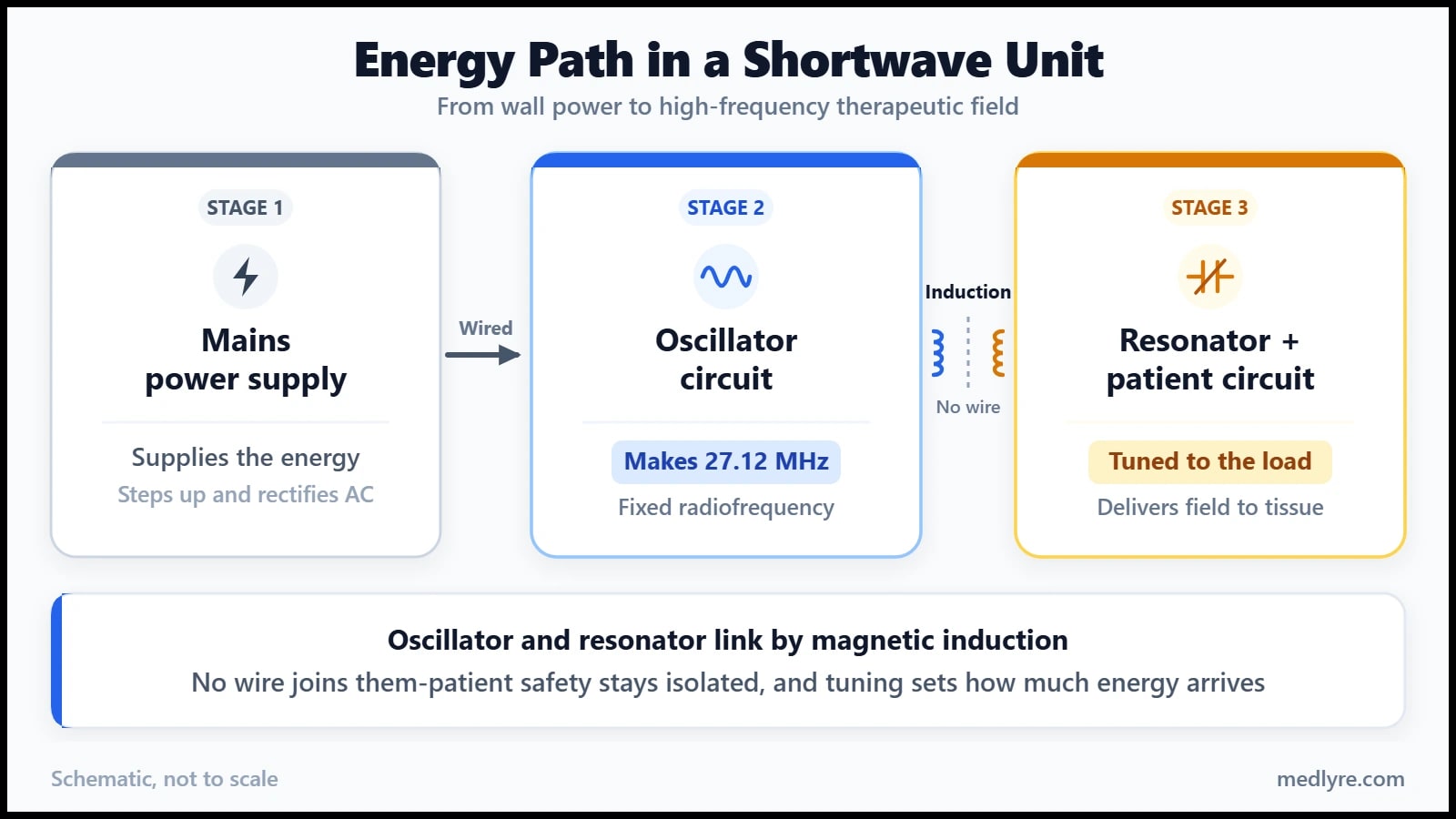
The oscillator comes first, because everything else depends on it. At its core sits an LC tank, an inductor () and a capacitor () passing energy back and forth the way a child on a swing trades height for speed. Left alone, the swing dies down, because resistance eats a little energy every cycle. A valve or transistor supplies a small push at the right moment of each cycle, so the oscillation keeps its size. The tank decides the frequency:
A bare tank drifts, though. Components warm up and the load changes. In the Clayton's Electrotherapy edited by Kitchen, the usual fix is described as locking the oscillator to a quartz crystal, which vibrates at one very precise frequency when voltage is applied (the piezoelectric effect).
Take the crystal out and see what gives way. The frequency starts to wander, and a machine that wanders leaves its licensed ISM slot and begins transmitting where someone else's radio lives. Regulation, in other words, turns into a circuit design requirement.
The oscillator never touches the patient. Its energy crosses to the resonator through a pair of coils with air between them, the same mutual induction a transformer uses, and that gap also keeps the patient electrically apart from the mains side.
The resonator holds a variable capacitor and the electrodes, and here is the bit that confuses everyone: the patient is part of this circuit. Pads, air gap, skin, fat and muscle all add capacitance and resistance, so the circuit's natural frequency shifts with every new set-up. When that natural frequency matches 27.12 MHz, energy crosses over well. When it doesn't, most of it never arrives. Tuning a shortwave unit resembles tuning a radio: the oscillator keeps transmitting at 27.12 MHz, and you adjust the resonator until it responds at that frequency.
Now suppose the patient shifts position mid-treatment. The air gap changes, the resonance slides off 27.12 MHz, and the energy delivered falls even though the intensity dial hasn't moved. The patient says the warmth is fading. A therapist who trusts the dial alone gets misled, which is why the two controls deserve a contrast anchor: intensity sets how much the oscillator generates, tuning sets how much of that crosses to the patient. (Many modern units tune themselves automatically, but the logic underneath is the same.)
Harmonics and the problem of a noisy neighbour
A perfect sine wave contains exactly one frequency. A real oscillator never produces a perfect sine, and any distortion in the wave can be written as the fundamental plus extra waves at whole-number multiples of it. Those extras are harmonics.
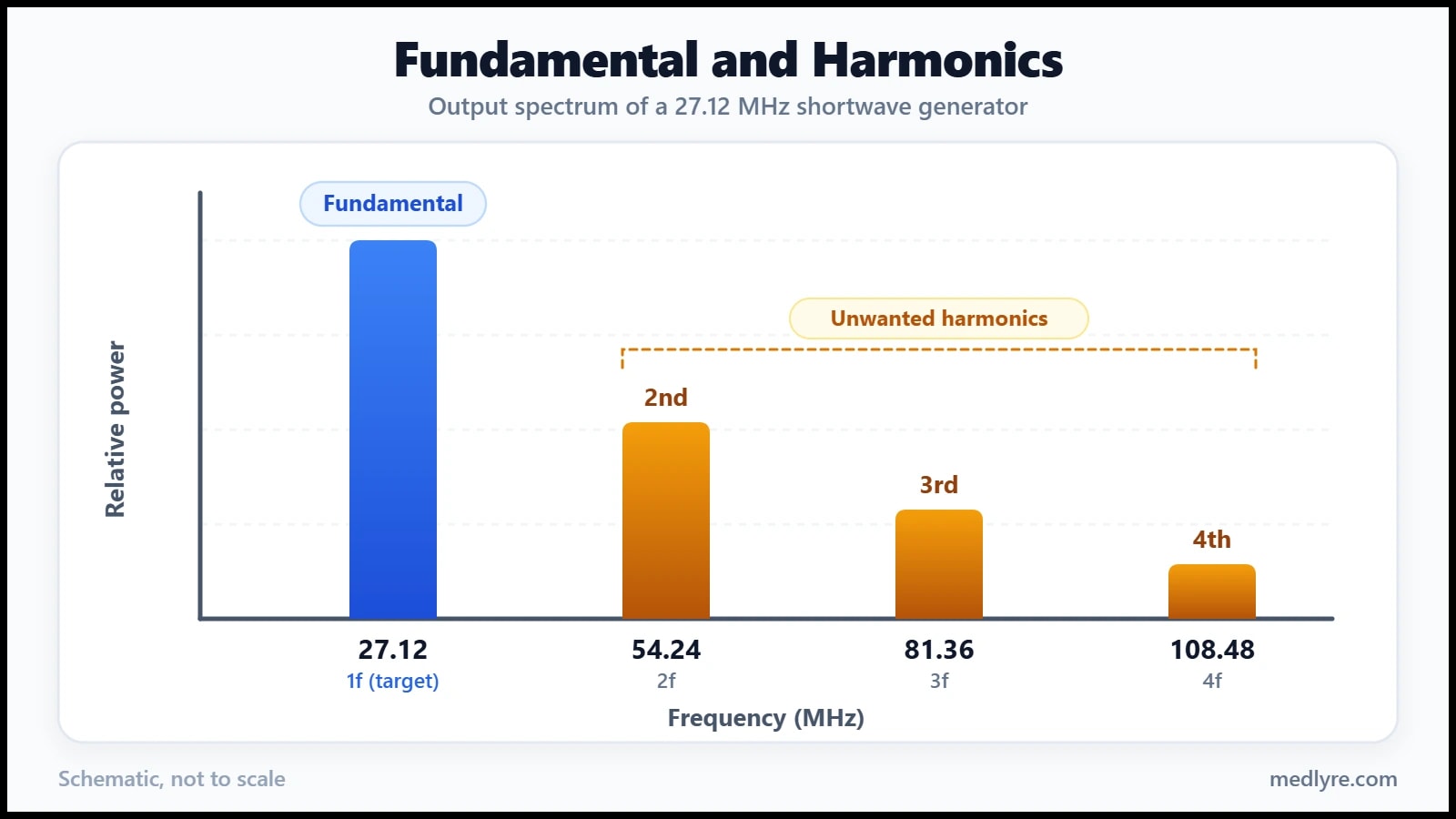
For a 27.12 MHz unit the harmonics fall at 54.24, 81.36 and 108.48 MHz, each usually weaker than the one before. The fourth lands just above the FM broadcast band, in spectrum used by aviation navigation radio. Your ISM permission covers the fundamental and its narrow tolerance window. It does not cover whatever else leaks out, so harmonics count as spurious emissions that other radio users never agreed to share.
Machine standards deal with this directly, and IEC 60601-2-3, the particular standard for short-wave therapy equipment, sets out requirements for these units. Designers answer with filtering in the output stage and shielding around the cabinet, and a well-tuned resonator helps too, because a circuit tuned to 27.12 MHz responds poorly to frequencies far from it. Some departments go further and screen the treatment room.
Two frequencies, two jobs
Pulsed shortwave still runs at 27.12 MHz. What pulses is the delivery: the carrier switches on in short bursts, at a pulse repetition rate of tens to hundreds per second. That repetition rate is a separate setting from the carrier frequency. Because the machine is off between bursts, the mean power falls, which is how pulsed delivery can stay below the thermal threshold.
Which tissue gets hot first?
Capacitor field favours tissue with high resistance; inductive field favours tissue rich in water and ions. That's the short answer, and the rest of this section is the mechanism behind it.
Heat in tissue follows the Joule relationship, : more current or more resistance means more heat. The oscillating field pushes ions back and forth (conduction), flips polar water molecules to and fro (dipole rotation) and, in a magnetic field, drives circular eddy currents through conducting tissue. Every one of these ends as friction between moving particles. The heat is made inside the tissue; the pads only shape the field.
| Capacitor field | Inductive field | |
|---|---|---|
| Dominant field | Electric | Magnetic |
| Applicator | Two plate or pad electrodes with an air or felt spacer | Coil: cable wound around the part, or a drum applicator |
| Heats most | High-resistance tissue in the field's path, such as subcutaneous fat | Low-resistance, water-rich tissue, such as muscle |
| Main mechanism | Dielectric and ionic heating | Eddy currents |
| Key set-up variable | Electrode spacing and skin gap | Coil position and distance |
Cameron's Physical Agents in Rehabilitation reports that the capacitor method tends to heat high-impedance tissue such as superficial fat more strongly. The textbook picture assumes fat and muscle lie in series with the field lines, and the pattern can shift when the arrangement changes, so treat it as a general trend rather than a fixed rule.
Equal air gaps on both sides give an even field. An electrode brought closer to the skin concentrates the field there and heats that side more, which can be useful and can also catch you out.
Shortwave and microwave behave differently because of wavelength. An 11 m wave dwarfs the human body, so shortwave works as an alternating field around the electrodes. At 2450 MHz the energy leaves a director (the microwave applicator) as a radiated beam and is absorbed mainly by water-rich tissue near the surface. Microwave units are much less common in clinics today than shortwave.
Dose is judged by feel, using the classic Schliephake scale: Dose I is subthermal (no sensation of heat), II is just-perceptible warmth, III is a moderate pleasant warmth and IV is strong but tolerable heat. Therapeutic tissue temperatures sit around 40 to 45 °C.
What does that heat do? It widens local blood vessels, raises the metabolic rate, makes collagen more extensible and lifts the pain threshold, which is the rationale for using it in subacute and chronic musculoskeletal conditions. Evidence for clinical benefit is mixed, so exam answers should present these as proposed effects of heating, not guaranteed outcomes.
Why the exam keeps asking about metal
Metal implants and jewellery concentrate eddy currents, so they can heat far above the surrounding tissue. Pacemakers can be disturbed by the field. Wet dressings and sweat pool heat and create hot spots. And because warmth is the dose guide, a part with impaired thermal sensation can overheat without anyone noticing. Other classic contraindications, such as pregnancy over the abdomen, malignancy, active bleeding and poor arterial supply, come from a different logic: extra heat and blood flow are unwelcome there. Sort your list by mechanism and it stops being a memory test.
The numbers and logic to carry into the viva
Ninety seconds before the viva
| Item | What to remember |
|---|---|
| High-frequency current | Above about 100 kHz; no nerve or muscle stimulation |
| Main shortwave frequency | 27.12 MHz, ISM band 26.957 to 27.283 MHz (±0.6%) |
| Wavelength | , about 11.06 m at 27.12 MHz |
| Other shortwave bands | 13.56 MHz and 40.68 MHz |
| Microwave | 2450 MHz (12.2 cm); also 915 and 434 MHz |
| Half-cycle at 27.12 MHz | About 18 ns, far too short for a nerve to fire |
| Oscillator | LC tank, , crystal-controlled |
| Resonator | Coupled by induction; patient is part of the circuit; retune per set-up |
| Intensity vs tuning | Intensity sets output; tuning sets how much crosses |
| Harmonics | 54.24, 81.36, 108.48 MHz; an interference and standards problem |
| Capacitor field | Heats high-resistance tissue such as fat |
| Inductive field | Heats water-rich tissue such as muscle, via eddy currents |
| Dose | Schliephake I to IV, judged by patient warmth |
Questions students keep asking about shortwave diathermy
Q. Why is shortwave diathermy always 27.12 MHz?
It isn't always, though most machines use it. The frequency sits in an ISM band the ITU reserves for equipment whose emissions may disturb radio users, and 13.56 and 40.68 MHz are also permitted bands. The ±0.6% tolerance around 27.12 MHz is one reason the oscillator uses crystal control. The number comes from radio regulation, with no special tissue physics behind it.
Q. Why doesn't a high-frequency current stimulate nerve or muscle?
Each half-cycle at 27.12 MHz lasts about 18 nanoseconds. A nerve membrane needs a current phase thousands of times longer to depolarise, so it never fires. What the patient does feel is heat, because thermoreceptors respond to temperature directly. That's also why thermal sensation matters for safety and for dosing.
Q. Why retune when the patient moves?
The patient sits inside the resonator circuit, so skin gap, electrode position and tissue all change its resonant frequency. Once that frequency drifts from 27.12 MHz, less energy crosses over from the oscillator, and the patient's warmth fades even though the intensity dial hasn't moved. Retuning restores the match. Many modern units do it automatically.
Q. Which field heats muscle, and which heats fat?
The usual textbook answer: the inductive field heats water-rich, low-resistance tissue such as muscle through eddy currents, while the capacitor field tends to heat high-resistance tissue such as subcutaneous fat more strongly. Electrode arrangement can shift this pattern, so treat it as a trend that your own textbook may qualify.
Q. Are harmonics a risk to the patient?
Textbooks frame harmonics as an interference and compliance problem: they land in spectrum used by other radio services, and standards such as IEC 60601-2-3 set requirements for these units. The sources I've drawn on don't establish a separate patient hazard from harmonics, so avoid claiming one in an exam answer.
Q. How does shortwave differ from microwave diathermy?
Shortwave (27.12 MHz, 11 m wavelength) delivers an alternating field around electrodes or a coil, so the body sits in the field. Microwave (2450 MHz, 12.2 cm) leaves a director as a radiated beam and is absorbed mainly by water-rich tissue near the surface. Different frequency, different delivery, different pattern of heating.
Read this before quoting in clinic
This article is teaching material for health-science students. The mechanisms, values and clinical correlations here are meant to build understanding, not to direct care. Any real-world application requires training, clinical judgment and supervision from your institution.
References
- Cameron MH. Physical Agents in Rehabilitation: From Research to Practice. Elsevier.
- Robertson V, Ward A, Low J, Reed A. Electrotherapy Explained: Principles and Practice. 4th ed. Butterworth-Heinemann; 2006.
- Kitchen S, ed. Electrotherapy: Evidence-Based Practice (Clayton's Electrotherapy). Churchill Livingstone.
- International Telecommunication Union. Radio Regulations, footnote 5.150 (ISM frequency bands).
- International Electrotechnical Commission. IEC 60601-2-3: Particular requirements for short-wave therapy equipment.